Buyer guide
The main apron types, the strap and pocket options, and every measurement and choice a specification needs so that a factory builds the apron you meant.
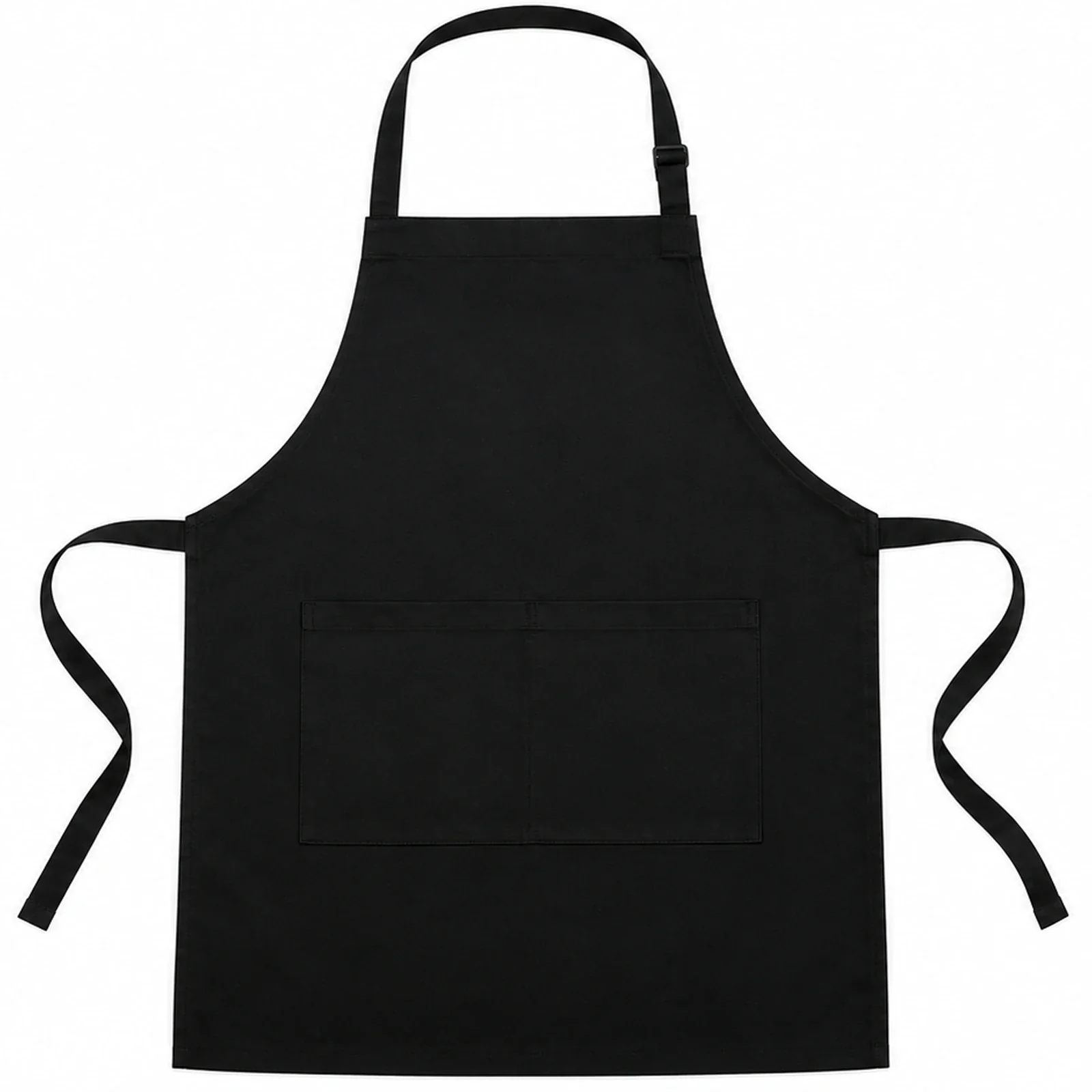 AI render
In short
The two basic aprons are the bib apron, which covers the chest and legs and hangs from a neck strap, and the waist apron, which ties at the waist and covers the legs. Beyond that, an apron is specified by its finished dimensions, strap and tie type, pockets, fabric weight and composition, colour, decoration and packing. Leaving a dimension out means the factory chooses it.
8 min read
Written by the AHM International product development team
Updated October 2026. Every worked figure is checked by automated tests.
The main types
| Type | Cover | How it is worn | Often used for |
|---|---|---|---|
| Bib apron | Chest to below the knee | A neck strap holds the bib; ties at the waist | Kitchens, butchery, grocery counters, workshops, any job with splashes at the chest |
| Waist apron (bistro, server) | Waist to below the knee | Ties around the waist, with no neck strap | Table service, bars, front-of-house hospitality, light retail |
| Cross-back apron | As a bib apron | Straps cross the back and fasten at the waist, so the weight sits on the shoulders | Long shifts and heavier fabrics, where a neck strap would tire the wearer |
Strap and tie options
| Option | What it is | Why choose it | Watch for |
|---|---|---|---|
| Adjustable neck strap | A strap with a slide buckle to set the bib height | Fits different wearers with one size | Buckle quality and the strap attachment, which is a stress point |
| Fixed neck loop | A sewn loop of fixed length | Simplest and cheapest, with no hardware | Fits only a narrow range of wearers |
| Cross-back straps | Two straps crossing between the shoulder blades | Spreads the load across the shoulders | More fabric and more sewing |
| Waist ties | Ties sewn at the sides, long enough to wrap and tie in front or behind | Secure and adjustable at the waist | Length, width and where the tie is anchored |
What a specification should state
Every item left out is a decision the factory makes for you.
- Finished dimensions
- Length from the top of the bib to the hem, width at the hem and at the chest, bib height, each with a tolerance.
- Straps and ties
- The type, length and width, the hardware, and how and where each is attached.
- Pockets
- How many, their size, their position measured from a fixed point, whether divided, and whether the openings are reinforced.
- Fabric
- Fibre composition, weave, weight and its tolerance, and the finish. Ask for a swatch.
- Colour
- A reference colour or a lab dip, with the tolerance for matching across lots.
- Decoration
- The method, the size and the position of each logo, and the artwork.
- Labels, packing and sizes
- The labels and their positions, how the aprons are folded and packed, and the size offered if more than one.
What makes an apron different from other garments
An apron is worn over everything else, so it takes the splashes, the soil and often the harshest laundering of any garment in the program. That is why the construction points are stress points: the pocket corners, the strap attachments and the points where the ties are anchored. How these are reinforced is one of the clearest differences between a good apron and a weak one.
Many apron programs use one size or two, so grading matters less than the dimensions of the single block, but it still has to suit the wearers. Fabric weight and fibre are chosen for the wash: a fabric that suits a pressed shirt may not survive an apron's laundering.
Ask the factory, do not assume
Which strap hardware a factory sources, how it reinforces pockets and which decoration it runs in-house vary between factories. These are questions for the factory that will make your apron, and the answers belong in the approved sample.
Related questions
A bib apron covers the chest and hangs from a neck strap; a waist apron ties at the waist and covers only the legs. Bib aprons protect more; waist aprons are lighter and cooler.
It depends on the job and the wash. Poly-cotton twill and canvas are common for aprons that are laundered often; the weight and blend should be chosen for the soiling and the laundering, and tested.
That is a design choice: one divided pocket, two or three separate pockets, or none. Specify the number, size and position, and reinforce the corners.
Aprons are often supplied in one size or a small range. Specify the finished length and width, and the strap adjustment range, rather than a size name.
Send one specification and we will apply exactly this thinking to your style. Construction, materials and commercial FOB costing.