Buyer guide
What a complete apparel tech pack contains, which gaps cause the most expensive problems, and what to do if you do not have one at all.
In short
A complete apparel tech pack contains a technical sketch, a bill of materials, a measurement chart with tolerances, construction notes, a fabric specification, a colour standard, decoration artwork, labelling requirements and a packing instruction. The two omissions that cost the most are missing tolerances and colour named without a reference standard. Both push decisions into production, where they are expensive to fix.
6 min read
Reviewed by AHM International product development team
Last reviewed August 2026
Why the tech pack decides the price
A quotation is a manufacturer's answer to a question. If the question is precise, the answer can be too. If it is vague, the manufacturer prices the worst reasonable interpretation, not out of bad faith, but because they will be held to the number.
That is the entire commercial argument for a good tech pack. Every open question in the document becomes an assumption in the price, and assumptions are always priced conservatively.
It also determines how many sample rounds you pay for. A resolved specification converges in fewer rounds because each sample is closing a written point rather than testing an interpretation.
The ten components
In roughly the order a manufacturer reads them.
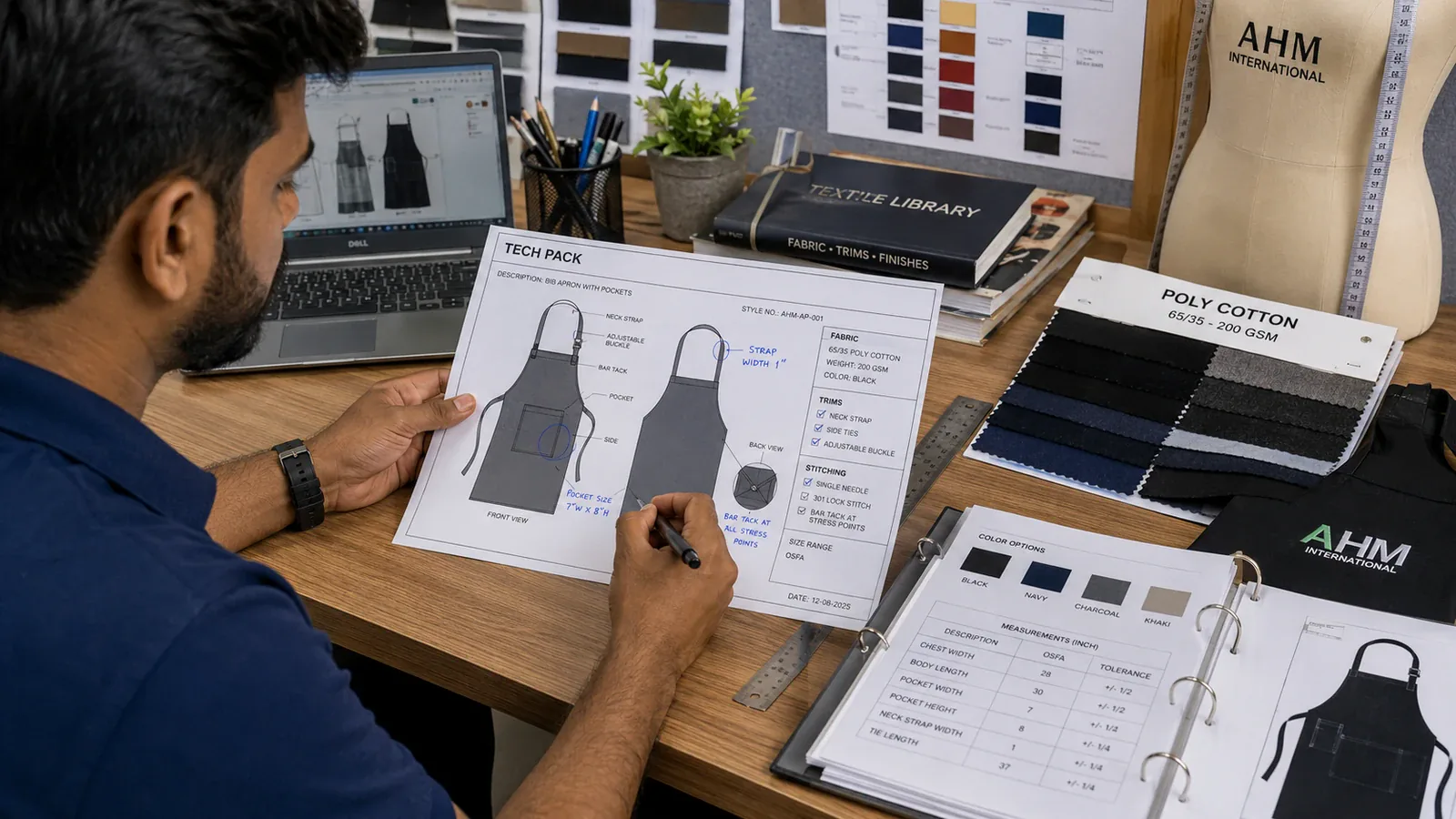
- 1. Technical sketch
- Front and back flat drawings, plus detail views of any construction that is not obvious from the flat. Proportion matters less than clarity.
- 2. Bill of materials
- Every fabric, trim, thread, label, hangtag and packaging component, with placement and quantity per garment.
- 3. Measurement chart
- Points of measure with values by size, and tolerances. See below on why tolerances are not optional.
- 4. Construction notes
- Seam types, stitch density, closure type and reinforcement, named against specific operations rather than described generally.
- 5. Fabric specification
- Composition, weight, construction and finish. Or, if you do not know, the requirement the fabric must meet.
- 6. Colour standard
- A physical swatch or a numeric reference for every colourway. A colour name is not a standard.
- 7. Decoration artwork
- Vector files with placement, size and colour references for every logo and print.
- 8. Labelling
- Main, care, size and country-of-origin labels with artwork, wording and placement.
- 9. Packing instruction
- Fold or hang, polybag specification, ratio or solid pack, carton marking artwork.
- 10. Grade rules
- How each measurement changes between sizes. Useful if you have them; we can develop them if not.
The five gaps that cost the most
Ranked by what they actually cost, not by how often they appear.
| Gap | What it causes | Cost to fix later |
|---|---|---|
| Measurement chart without tolerances | Inspection has no objective criteria; pass or fail becomes a negotiation after production | High. Disputes at final inspection |
| Colour named but not referenced | Lab dip cannot be approved objectively; shade disputes across reorders | High. Affects every repeat order |
| Fabric named without composition or weight | Several valid interpretations, all priced differently | Medium, usually caught at quotation |
| Logo supplied as a raster image | Cannot be digitised or separated cleanly; extra approval rounds | Low to medium. Costs time |
| No packing instruction | Carton sizing changes late, altering your freight cost after price agreement | Medium. Surfaces after the price is agreed |
Why tolerances matter more than measurements
A measurement chart states the target. A tolerance states what is acceptable. Without the second, there is no objective way to decide whether a garment passes, which means the decision gets made during inspection, under time pressure, by two parties with opposing interests.
Tolerances are also a cost lever. A tight tolerance on a measurement that does not affect fit adds inspection time and rejection rate for no benefit. Deciding deliberately where you need precision, and where you do not, is worth doing before production rather than defending afterwards.
If you do not have tolerances, say so. A manufacturer can propose them from the article type, and agreeing them at development takes minutes.
If you have no tech pack
Send a reference garment instead. A physical sample answers construction questions a written document usually leaves open, and it can be measured directly. A sketch with written notes also works. What matters is that the requirement is clear enough to quote, and where it is not, a good manufacturer asks rather than assumes.
Related questions
No. Tech packs are commonly produced in Excel, and a clear spreadsheet with a hand sketch and photographs is entirely workable. Precision of information matters more than the tool used to present it.
That is normal practice and worth doing, but send the same document to each. Comparing quotations against different specifications tells you nothing about which supplier is better value.
You do, where the design and specification originate with you. Where a manufacturer develops a pattern from your reference garment for your program, it is developed for that program.
Send one specification and we will apply exactly this thinking to your style. Construction, materials and commercial FOB costing.