Fleece & Sweatshirts · Current capability
The most worn garment in most uniform and merchandise programs: a hood, a kangaroo pocket and a fleece body, each with decisions that decide how it looks after a season.
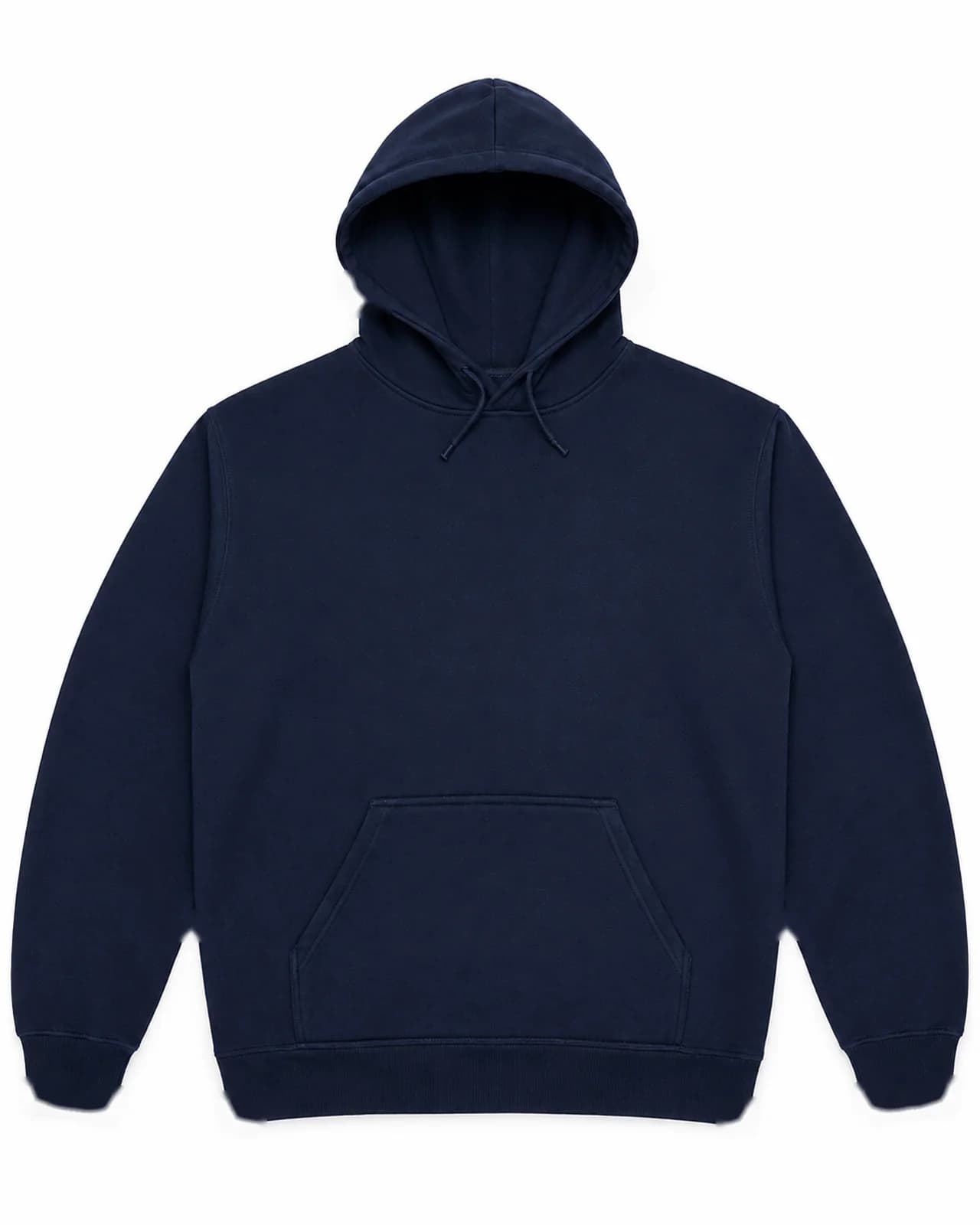 AI render
In short
A pullover hoodie is specified by fabric and weight, hood construction (two- or three-panel, lined or not, with or without drawcord), the kangaroo pocket, sleeve style and rib trims. The hood is what wearers notice: a lined three-panel hood holds its shape better than a single-layer two-panel one.
Construction choices
- Hood
- Two-panel or three-panel, single layer or lined in self or jersey, with cord and eyelets or without.
- Kangaroo pocket
- One front pouch, its opening edges reinforced at the corners.
- Drawcord
- Flat or round cord, with metal or plastic tips or knotted ends. Children's sizes follow drawcord rules.
- Rib trims
- Cuffs and hem in rib with elastane.
- Neck finish
- Taped inside the back neck, sometimes with a hanging loop.
Size chart
The points a size chart for this garment needs, and how each is taken. Give every one a value and a tolerance for each size, and measure the sample after washing.
| # | Point | How it is measured |
|---|---|---|
| 01 | Chest | Measured flat, 2.5 cm below the armhole, doubled. |
| 02 | Body length | High point of shoulder to the bottom of the hem rib. |
| 03 | Sleeve length | Centre back neck to cuff edge. |
| 04 | Hood height | From the neck seam to the top of the hood, laid flat. |
| 05 | Hood width | Across the hood at its widest, laid flat. |
| 06 | Pocket opening | Height of each pocket opening, and pocket width at the base. |
- Fabric options
- Brushed-back fleece, French terry
- Typical weight
- 280-380 gsm
- Hood
- Two or three panel, single or lined
- Drawcord
- With or without; tips and eyelets to specification
- Minimum quantity
- Discuss with commercial team
- Sampling
- Discuss with commercial team
- Lead time
- Discuss with commercial team
Weights shown are typical ranges for this product class, given for orientation only. Final composition, weight, construction and finish are confirmed against your specification during development.
Logo positions
- Full front above the pocket
- Left chest
- Full back
- Sleeve
- Hood side
Decoration methods
- Embroidery
- Screen print
- Applied patches
- Heat transfer
- Tonal debossing
Already buying?
Already buying this pullover hoodie? Let us benchmark it.
Share your existing specification, construction requirements and estimated quantity for a manufacturing and FOB costing review of the same garment. There is no instant price: a comparison is only useful when both quotations describe the same article.
01
You send the reference
The current garment's tech pack, or clear photographs with its measurements. Add the quantity and destination.
02
AHM reviews the construction
Fabric type, weight and back finish, hood construction, zip and pockets, rib trims, colour standard, decoration placement, labels and packing, read from the reference rather than assumed.
03
Open points are clarified
Anything the reference leaves open is asked about before costing, so the price answers the question you asked.
04
An FOB quotation is prepared
On the same basis as the garment you buy now, so the two can be compared line by line. The final price depends on the confirmed specification and commercial approval.
Buyer questions
A three-panel hood has a centre strip that gives it a rounder shape and better fit; a two-panel hood is simpler and cheaper.
A lined hood is warmer, holds its shape and looks finished inside. A single layer is lighter and cheaper.
A print over the pocket edge breaks at the seam. Place the print above the pocket, or decorate the pocket piece before it is sewn on.
A tech pack, a reference garment or a written requirement is enough to start. We come back on construction, materials and FOB costing.
Explore next
Explore next
All fleece & sweatshirts
Sweatshirts, hoodies and full-zip fleece: the layer that gets worn outside the building, which makes it the most visible garment in the program.
Crewneck Sweatshirt
A round-neck sweatshirt with rib at neck, cuff and hem. No hood or zip to hide behind, so the fabric, the rib and the fit carry the whole garment.
Full-Zip Fleece Jacket
A zip-front fleece, hooded or collared, worn as a layer or as the outer jacket. The zip, the pockets and the fleece's pilling resistance decide its life.
Hoodie and Sweatshirt Specification: Fabric, Weight and Construction
A hoodie or sweatshirt is specified by its fabric (brushed fleece, French terry or polar fleece), fibre blend, weight in gsm, hood construction, rib trims, pockets, closures and decoration.