Polos & T-Shirts · Current capability
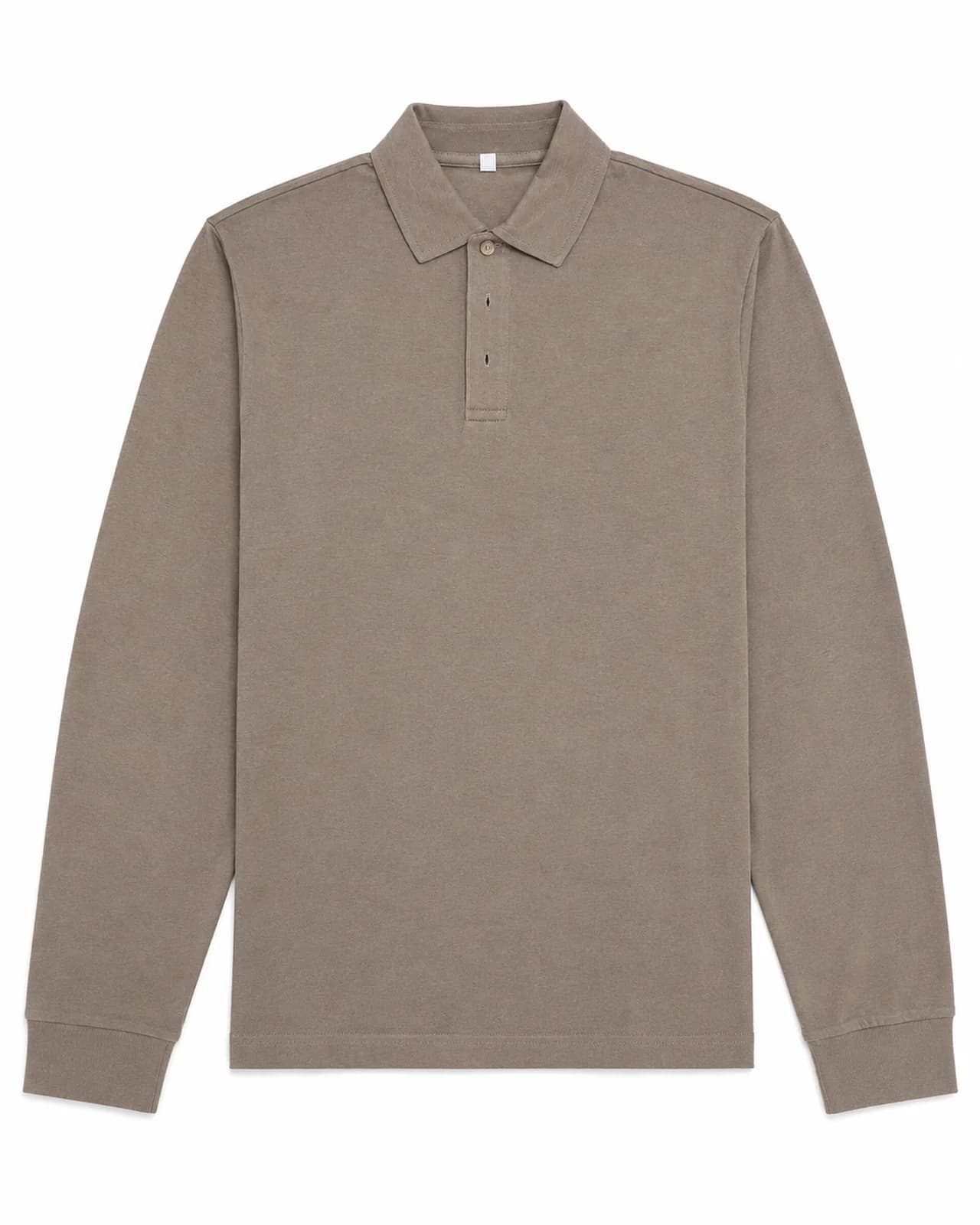
The polo for cold stores, early shifts and winter programs: the same collar and placket as the short sleeve, with a rib cuff that has to stay put through washing.
 AI render
In short
A long-sleeve polo is specified like a short-sleeve one, with two more decisions: the cuff, usually knitted rib, and the sleeve length across the size range. Rib cuffs lose their grip if the rib has no recovery, so the rib's composition matters. Long-sleeve polos often use a slightly heavier fabric than the short-sleeve style in the same program.
Construction choices
- Rib cuff
- 1x1 or 2x2 rib, ideally with elastane so it recovers after washing.
- Matching collar
- Flat-knit to match the cuffs in colour and stripe.
- Side vents
- Short vents at the hem so the polo sits over trousers.
- Sleeve length by size
- Graded through the range, with tall lengths where needed.
Construction
AI render- 1
Collar
A polo collar. Whether it is flat-knit or self-fabric, its height and any tipping are specified per order.
- 2
Button placket
A short placket with buttons. Placket length, the number of buttons and the button type are set in the specification.
- 3
Rib cuffs
Long sleeves finished with a rib cuff. Cuff depth and rib composition follow the specification.
- 4
Straight hem
A straight hem on this style. Side vents and a longer back hem are options to specify, not defaults.
Marked on an AI render of the style. Fabric, stitch types, labels and packing are specified per order and are not shown here. No feature above is standard on every polo.
Size chart
The points a size chart for this garment needs, and how each is taken. Give every one a value and a tolerance for each size, and measure the sample after washing.
| # | Point | How it is measured |
|---|---|---|
| 01 | Chest | Measured flat, 2.5 cm below the armhole, doubled. |
| 02 | Body length | High point of shoulder to front hem. |
| 03 | Sleeve length | Centre back neck to cuff edge, so different shoulder widths compare fairly. |
| 04 | Cuff height | Depth of the rib cuff. |
| 05 | Cuff opening | Across the cuff, relaxed and stretched. |
| 06 | Vent length | Height of the side vents. |
- Fabric options
- Cotton or CVC pique, performance pique
- Typical weight
- 200-260 gsm
- Cuffs
- Rib with elastane for recovery
- Hem
- Straight with side vents, or tennis tail
- Minimum quantity
- Discuss with commercial team
- Sampling
- Discuss with commercial team
- Lead time
- Discuss with commercial team
Weights shown are typical ranges for this product class, given for orientation only. Final composition, weight, construction and finish are confirmed against your specification during development.
Logo positions
- Left chest
- Upper sleeve
- Forearm
- Back neck
Decoration methods
- Embroidery
- Screen print
- Heat transfer
- Printed neck label
- Woven badges
Already buying?
Already buying this long-sleeve uniform polo? Let us benchmark it.
Share your existing specification, construction requirements and estimated quantity for a manufacturing and FOB costing review of the same polo or T-shirt. There is no instant price: a comparison is only useful when both quotations describe the same article.
01
You send the reference
The current polo or T-shirt's tech pack, or clear photographs with its measurements. Add the quantity and destination.
02
AHM reviews the construction
Knit construction and weight, collar and cuff, placket length and buttons, neck finish, colour standard, decoration placement, labels and packing, read from the reference rather than assumed.
03
Open points are clarified
Anything the reference leaves open is asked about before costing, so the price answers the question you asked.
04
An FOB quotation is prepared
On the same basis as the polo or T-shirt you buy now, so the two can be compared line by line. The final price depends on the confirmed specification and commercial approval.
Buyer questions
The rib loses its recovery. A rib with a little elastane, and a cuff that is not too loose to begin with, keeps its grip; test on a washed sample.
Often slightly, for warmth, but the two can share one fabric if the program needs them to match exactly.
Yes, on the upper arm or the forearm. Forearm logos are placed so they read when the arm hangs.
A tech pack, a reference garment or a written requirement is enough to start. We come back on construction, materials and FOB costing.
Explore next
Explore next
All polos & t-shirts
The highest-volume item in most uniform programs, and the one where collar recovery and colour consistency across reorders decide whether a buyer stays.
Classic Short-Sleeve Polo
The default uniform top: a knitted collar, a short placket and a pique or jersey body that takes an embroidered logo better than almost anything else.
Crew-Neck Uniform T-Shirt
The simplest garment in the range and the easiest to get wrong: a neck that bags, a side seam that twists, a print that cracks. Each is a specification decision.
Pique vs Jersey for Polo Shirts
Pique is a textured knit with a raised waffle structure that holds shape, hides light soiling and resists showing creases, which is why most uniform polos use it.
Embroidery vs Screen Printing
Embroidery is priced by stitch count and is largely indifferent to the number of colours; screen printing is priced by colour count and is largely indifferent to design size.
Knit Constructions Explained for Uniform Buyers
Single jersey, pique, rib and fleece are different constructions, not different marketing names for the same cloth.
Heat Transfer vs Screen Print for Uniforms
Screen print lays ink on the fabric through mesh; heat transfer applies a prepared graphic with heat and pressure.